Book marketing consultant Michael Alvear commissioned an eye tracking study of Amazon book shoppers to serve as the centerpiece of his new guide, Make A Killing On Kindle. The result is a fascinating look at what shoppers do when they land on one of Amazon’s book pages. Here’s an infographic that neatly summarizes the top three reveals. Click here to see the full heat map and here for his book detailing new marketing strategies that grew out of the eye tracking study.
Michael Alvear is a book marketing consultant and ad veteran of 20 years, once winning Adweek’s prestigious Media Plan Of The Year. He is a hybrid author represented by the Handspun Literary Agency and has also self-published fifteen books.
This infographic from the editing and proofreading team at ProofreadingServices.com offers 128 words to help writers avoid using "very" in their projects. Although "very" adds little to a description, authors often struggle to find stronger phrasing. With the help of this infographic, however, writers can spruce up their manuscripts and avoid writer's block simply by substituting any "very" phrases with more effective alternatives from the chart.
ProofreadingServices.com offers editing and proofreading packages for writers of all genres. We believe every writer can strengthen his or her material based on the experience of a professional editor, and we work with authors based on their unique goals, suggesting structural and stylistic changes as well as eliminating errors in grammar, spelling, and punctuation. To learn more about how our editing team can help you take the next step toward publication, please visit http://www.proofreadingservices.com/products/service to request a free sample and quote.
There are lots of different types of editing, and as an author it's important to know the differences.
This video is a quick summary of the main types of editing:
For those of you that prefer an image, here's an infographic:
We tend to stereotype people in certain occupations.
Lawyers are perceived as argumentative, accountants as humorless, and teachers as nurturing. Writers, it seems, are eccentric and mired in self-doubt (think Bradley Cooper's character in the movie Limitless). To be more uncharitable, writers can also be viewed as self-adsorbed, voluminous drinkers, and heavy smokers.
You might think that writers would make terrible friends then. However, you'd be wrong.
As the founder of an editing company that specializes in book editing, I've met a lot of writers, and formed some great friendships with them too. In fact, I think they make pretty terrific friends (just not for the reasons you might think).
So, here are 8 very surprising reasons why writers make incredible friends.
Ever get stuck finding just the right word to make your sentence perfect? Have you dug out your thesaurus but failed to find the word that truly completes the phrase?
You're not alone.
I was recently contacted by the lovely people at AussiEssay with an infographic about popular words as coined and first used by authors.
Here's the infographic:
We do, in fact, have writers like William Shakespeare to thank for a lot of the language we now consider mainstream.
So the next time you're stuck for just the right word, why not create a new one of your own :)
Want to set up an effective sales page for your book? Answer was "YES!" right? Well it just so happens that I was recently contact by Tom Morkes about this very topic. Tom has put together this awesome infographic to show an effective sales page set up: Like this? Learn how to sell more books with Tom Morkes. Do you have sales pages on your website for your books? Is your set up similar to this model? Share the link to your book sales page in the comments section below so we can all check out some examples.
I was recently approached by the team at Unplag with their latest infographic. I think it's pretty interesting, and hits on an important topic that will hopefully provide you with some writing motivation.
When we see the names of famous writers we rarely think of them as more than writers. That's what they are known for. They gained fame and recognition due to their talent with words. But what about before they reached success?
This infographic takes a look at their more humble beginnings and is a great reminder that we all start some where... even in places that have nothing to do with writing at all.
So if you ever feel discouraged about your writing career as you work your other job, just think about these writers and where they started out. Then, when you finish your shift, go write something brilliant.
I know that my writing space doesn't exactly fit with what's shown below. I didn't measure up too badly though. I do have a printed quotes for inspiration hung by my desk though. I personally love this poster https://www.etsy.com/it/listing/129178728/writers-write-art-print-author-quote?ref=shop_home_active_17. I have a large window next to my desk for natural light but I've never given much thought to the type of lighting I have. I have have lots of bookshelves, highlighters (and large amounts of other stationary), post-it notes, and other note pads. My desk area is mainly white but I do have light blue accessories so I'll count that one too ;)
I'll give myself a half point for being a tea drinker. I prefer black tea with milk and lots of sugar, but I do drink green tea too.
I personally don't like to work at a computer standing up. My office chair is pretty basic so I guess I lose points there too. I do have an back massager that fits on it though which does a great job of kneading out tension when required.
I also lose points for not having a plant. I love plants but unfortunately they don't love me and so tend not to last very long in my house.
Overall I think I measured up quite well. Of course, I don't work at my desk all the time. In fact, you're much more likely to find me in my reclining armchair with my laptop or out on my balcony with my tablet or smartphone.
What about you? Does your writing space fit the image below? How do you organise your writing space?
This infographic was sent to me by the lovely people at Essay Mama. It's a nice reminder that it's never too late to start writing your bestseller.
As a side note, Angela's Ashes is one of my all time favourite books.
Now, regardless of how old you are, go write something ;)
Today's post is all about using plain English. I think you’ll agree that official documents can be confusing. To help, President Obama signed thePlain Writing Act of 2010 requiring that Federal agencies use "clear Government communication that the public can understand and use." Regardless of where you stand politically, I'm sure you'll agree, making sure wording can be understood by the general public is a good thing.
The Grammarly team decided to find out if Federal agencies have indeed started communicating in plain English. Here's what we learned:
NASA, the Department of Health and Human Services, and the Department of Treasury communicate the most clearly to the public.
Top writing mistakes among Federal agencies include long sentences, passive voice, sentence fragments, redundant prepositions, dangling modifiers, redundant phrases, and more.
This is the inforgraphic they made with the results:
Whilst most of you probably aren't writing Government communications, have you thought about whether or not your writing can be easily understood by your readers? Are you writing clearly? This applies to both your books, and your marketing.
I was recently contacted by the lovely people at Ninja Essays with the below infographic about Top Writing Tools of Famous Authors.
I personal tend to brainstorm and make notes with pencil and paper, and then write my manuscripts on my laptop using Microsoft Word.
What writing tools do you use?
I was recently contacted by the team at Essay Tigers about "How to become a successful freelance writer". Check out this great infographic they put together:
How to become a successful freelance writer [Infographic] by the team at EssayTigers
Are you a freelance writer? Got some tips of your own about building a freelance writing business? Leave a comment below.
So, I got sent an email from the Content Manager at Global English Editing with a suggestion to use their infographic 10 Reasons Why Writing is Better Than Sex in a blog post here at Writers and Authors. Always on the look out for interesting, writing related content, I hopped on over to their website to check out the infographic in question. Giggles followed...
Each of the social media sites has its own etiquette. This infographic gives a good overview of points you should consider for Facebook, Twitter, Google+, Instagram, LinkedIn, and Pinterest.
Key takeaways:
1) One of the common themes you'll notice is engagement. All social media sites are about being social. Don't forget to interact with other users.
2) Contribute, don't spam.
You can see a bigger version of this infographic at
http://www.vocus.com/blog/infographic-a-pr-pros-guide-to-social-media-etiquette/
What tips for etiquette on social media do you have to share? What posting behaviour annoys you on particular social media sites? Leave a comment below with your 2 cents.
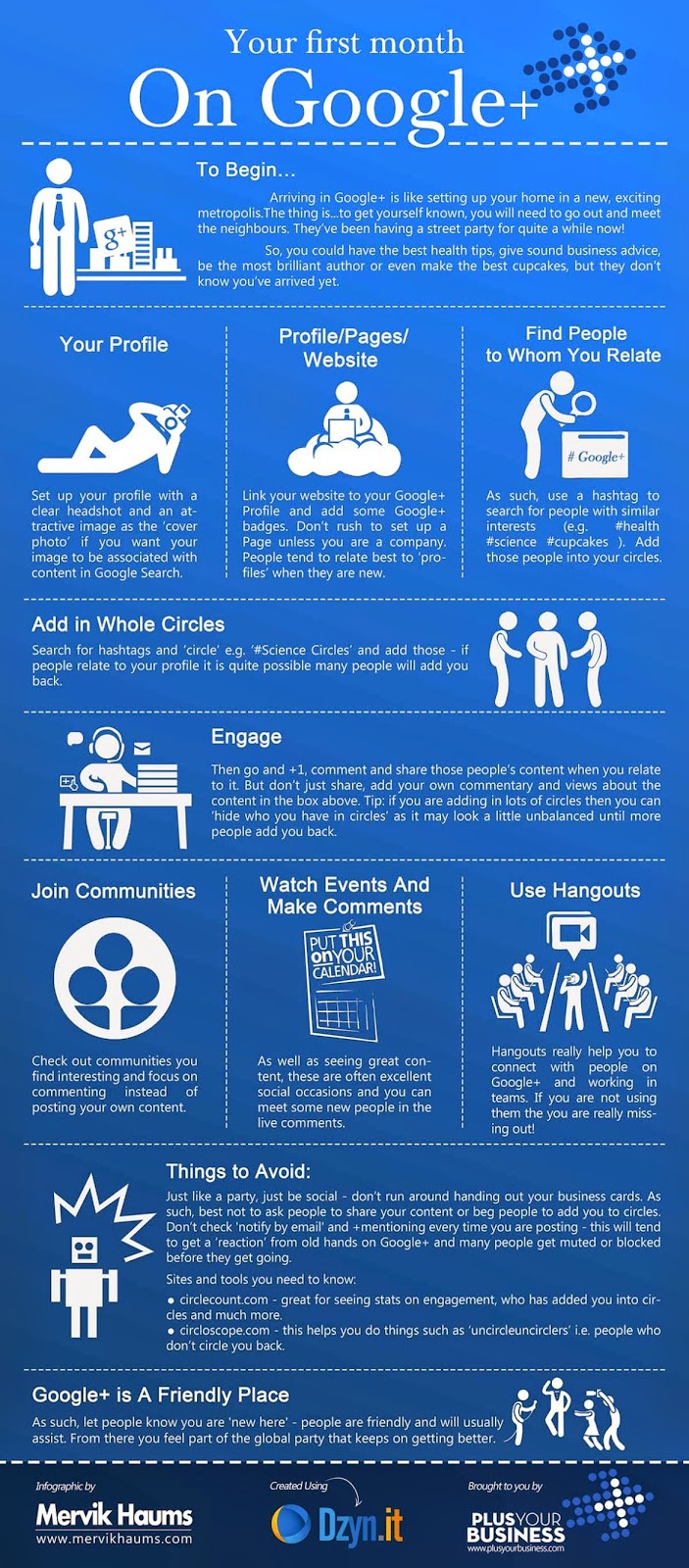
Being on Google+ has many advantages. The social media site is after-all part of Google. Getting started on Google+ can seem a bit daunting though. It's different from Facebook, Twitter, and other mainstream social media sites and offers a wide variety of features. This infographic (found at http://www.infographicscreator.com/2014/07/20/infographic-your-first-month-on-google/) gives a nice over view of how to get started.
Here's a few takeaways:
1) Set up your profile with a clear, professional avatar and profile header banner.
2) Link your website to your Google+ profile.
3) Use hashtags to find people in your niche.
4) Add whole circles.
5) +1, comment, and share other people's content.
6) Join communities.
7) Make new connections via events and hangouts.
8) Be social and have fun.
Are you using Google+? Any tips for newbie users? Leave a comment below with your 2 cents.
Coming up with new ideas for content to share via social media eating into your writing time? What if I told you its possible to expand you reach and save time and effort by re-purposing your work? Jumping for joy? Thought you would.
This infographic gives you a few ideas of how you can re-purpose your content for maximum social media impact. Each piece of content can be tailored to the strengths of each site.
Are you re-purposing your content? What formats do you normally use? Leave a comment below with your feedback.
Video is a powerful medium and YouTube is the leader of the pack when it comes to online video distribution. It is also a great site to use to reach an international audience online.
I came across this infographic at PostPlanners.com and thought you all might be interested in these statistics. You might be surprised to find out that 80% of YouTube visits come from outside the US. Therefore, if you're specifically trying to reach a non-US audience, or your book is available in multiple languages, you might want to consider uploading some videos to YouTube.
Are you using YouTube as part of your marketing plan? Is it helping you reach different audiences compared to your other social media networks like Facebook, Twitter, etc...? Leave a comment below with your feedback.
We are no longer .com and have gone back to being a .blogspot.com site. Some graphics on site may therefore not show the correct url. Sorry for any inconvenience.







 Reasons Why Writers Make Incredible Friends)


